Case Studies

Protecting Te Waikoropupū Springs through farmer-led change

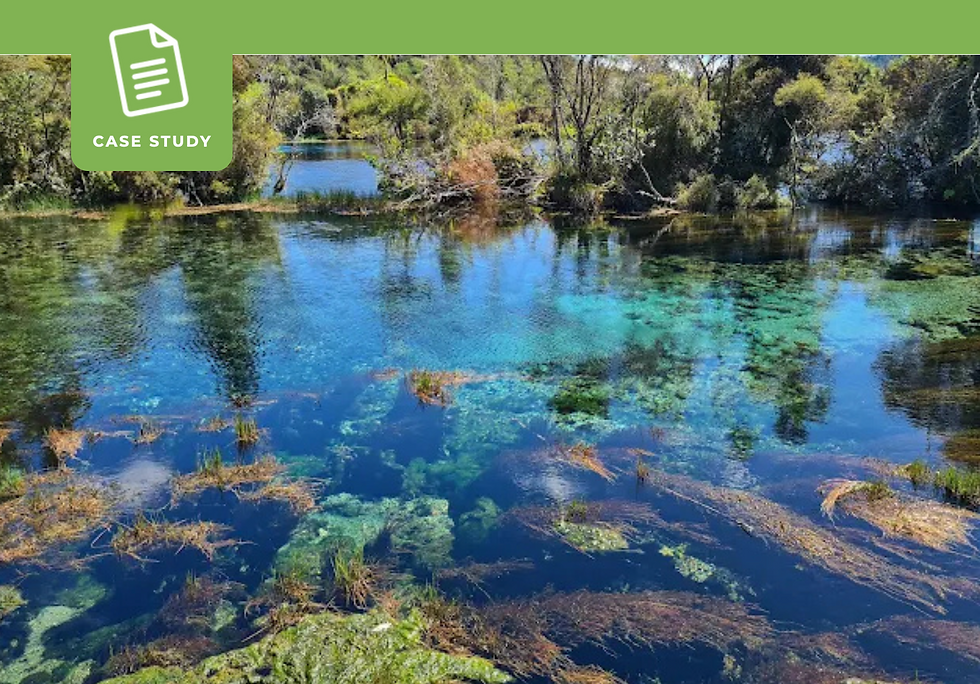
For Nigel Harwood and his family, farming on the Tākaka Marble Aquifer in Golden Bay carries a strong sense of responsibility. Their dairy operation sits above the aquifer that feeds Te Waikoropupū Springs - New Zealand’s largest cold-water springs and a site of deep cultural and spiritual significance to mana whenua. While regulatory frameworks continue to evolve, the Harwoods have chosen to act early, investing in environmental improvements aimed at protecting water quality for the long term.
Across their 319-hectare dairy farm operation they are milking 885 crossbreed cows, with an additional 187 hectares of dairy support land for youngstock grazing and supplementary feed.
Since the monitored baseline year of 2016/17, there has been a 13% reduction in modelled nitrogen leaching, decreasing from around 63 kg N/ha to 55 kg N/ha across the dairy platform and associated support land within the aquifer recharge zone.
Importantly, this has been achieved while maintaining a similar herd size and increasing milk production by approximately 14%, rising from about 337,000 kg of milksolids to 386,000 kg. Demonstrating that environmental gains don’t have to come at the cost of productivity and profitability, when management is targeted and data-driven.
A key turning point in this progress has been the Harwoods’ investment in understanding the farm at a much finer scale. Through involvement with Farmers Across the Marble Aquifer (FAMA) and support from Fonterra, Nigel has adopted high-resolution soil mapping to better identify areas of environmental risk. Work completed by Landscape DNA and Land and Water Science revealed significant variation in soil types and vulnerability to nitrate leaching across the property.
This has enabled a shift away from uniform management toward a more tailored approach, where different parts of the farm are managed according to their specific risk profiles. In practice, this includes adjusting grazing intensity, changing calving locations and refining land use decisions on the most sensitive areas.

Nutrient management practices have also been strengthened. Fertiliser application is now guided by regular soil testing and is no longer applied to effluent blocks, reducing unnecessary nutrient loading in high-risk areas.
The Harwoods are also progressing plans to expand their effluent application area and incorporate pivot irrigation technology, allowing effluent to be applied more precisely and only when soil moisture conditions are suitable. Modelling suggests these changes could reduce nitrogen leaching by a further 11%, potentially bringing total reductions to around 25% from the original baseline.
Feed strategy has been another important lever for change. The herd’s diet has been adjusted to reduce excess nitrogen intake and subsequent excretion. Low-protein supplements such as barley and fodder beet are now used more deliberately to balance overall dietary protein levels. In addition, fodder beet is harvested and fed out rather than grazed in situ, helping reduce nitrogen losses during wetter, high-drainage periods when leaching risk is highest.
Alongside changes to pasture and feed management, the Harwoods have invested in a range of nature-based solutions designed to slow, filter and treat water moving through the farm system. Open grazeable drains have been planted with filtering vegetation to help capture sediment and nutrients before they leave the farm.
Constructed wetlands provide further treatment by using natural biological processes to remove nitrogen, while innovative “leaky weirs” slow water flow, allowing sediment to settle and form small wetland areas. These leaky weirs and wetlands also provide nature-based solutions for flood management, reducing peak flows while improving water quality.
Together, these interventions reflect a long-term, whole-farm commitment to protecting the Tākaka Marble Aquifer and the iconic Te Waikoropupū Springs. Rather than relying on a single solution, the Harwoods have combined data-driven land use decisions, improved nutrient efficiency and supported natural systems to reduce environmental risk while maintaining strong herd production outcomes. Their approach highlights how farmer-led action, supported by targeted investment, can deliver meaningful environmental improvements in sensitive catchments, without compromising farm profitability.